

There are 163 million .com domains in the world. There are 12 million .net domains. That’s thirteen to one. And it explains almost everything about .net vs .com. Not because .com is better built; it isn’t. The two extensions are identical in every technical way that matters. But people have seen .com thirteen times more often. Familiarity becomes trust, quietly, without anyone choosing it.
That said, .net still wins in a few specific cases. Let’s go through both sides.
So What Actually Is a Domain Extension?
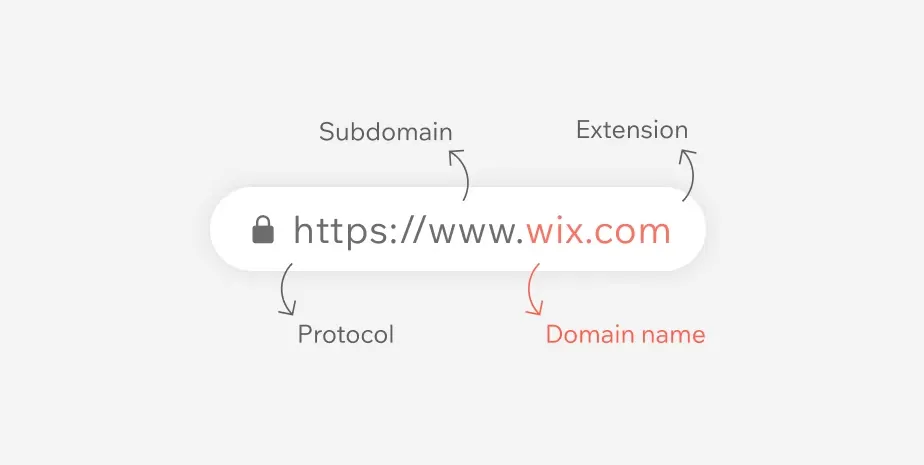
Credit: wix.com
The extension is the part after the final dot. In hashtagmedia.ae, the extension is .ae.
The formal name for it is a top-level domain, or TLD. You’ll see that abbreviation in every domain article you read, so it’s worth knowing.
Think of your extension as a neighbourhood. The street address is yours alone, the neighbourhood is shared with millions of other sites, and it carries a reputation you inherit for free.
One thing worth knowing early: domain registration isn’t ownership. You hold a licence for one to five years, sometimes ten. Miss the renewal, and it goes back on the market.
Let’s Break a Web Address Into Pieces
Take https://www.yourbrand.com/services. Five parts, and only one of them is today’s argument.
- https:// is the protocol. HTTPS security comes from an SSL certificate on your server, not from your extension. A .net can be just as secure as a .com.
- www is a subdomain. Optional, and honestly a bit old-fashioned now.
- yourbrand is the second-level domain; this is the part you choose and register.
- .com is the top-level domain. The extension, and this is our whole topic.
- /services is the path. This is where your site structure lives, and it does far more for rankings than the extension ever will.
Everything except that one dot-something is fully under your control.
.net vs .com: What’s the Real Difference?
Technically? Nothing at all.
Both extensions launched in January 1985, in the same first batch. The .com stood for commercial, the .net stood for network, and it was built for internet service providers, hosting companies, and infrastructure firms.
Those meanings held for about a decade. Then the dot-com boom arrived, and .com swallowed everything: shops, blogs, magazines, portfolios, everyone.
So the real difference today is perception, and the size of the gap is easy to miss.
As of March 2026, Verisign’s own registry data puts the .com base at 163.6 million domains. The .net base sits at 12.4 million. That’s roughly thirteen .com sites for every one .net.
That market share is the whole answer. People have seen .com about thirteen times more often. Familiarity turns into trust without anyone deciding to trust it.
.com vs .net at a Glance
Here’s the cost comparison and everything else, side by side.
| .com | .net | |
|---|---|---|
| Launched | January 1985 | January 1985 |
| Original purpose | Commercial businesses | Network and internet infrastructure |
| Who uses it now | Everyone | Tech firms, ISPs, communities, backup option |
| Domains registered | ~163.6 million | ~12.4 million |
| Availability | Hard. Most good names are gone | Much easier |
| Typical price | $10 to $30 a year | $12 to $25 a year |
| Brand recognition | Instant, worldwide | Mixed outside tech |
| People remember it | Yes, by default | Often typed as .com by mistake |
| Direct impact on SEO | None | None |
| Best for | Almost every business | Networks, tools, forums, IT services |
The Different Families of Domain Extensions
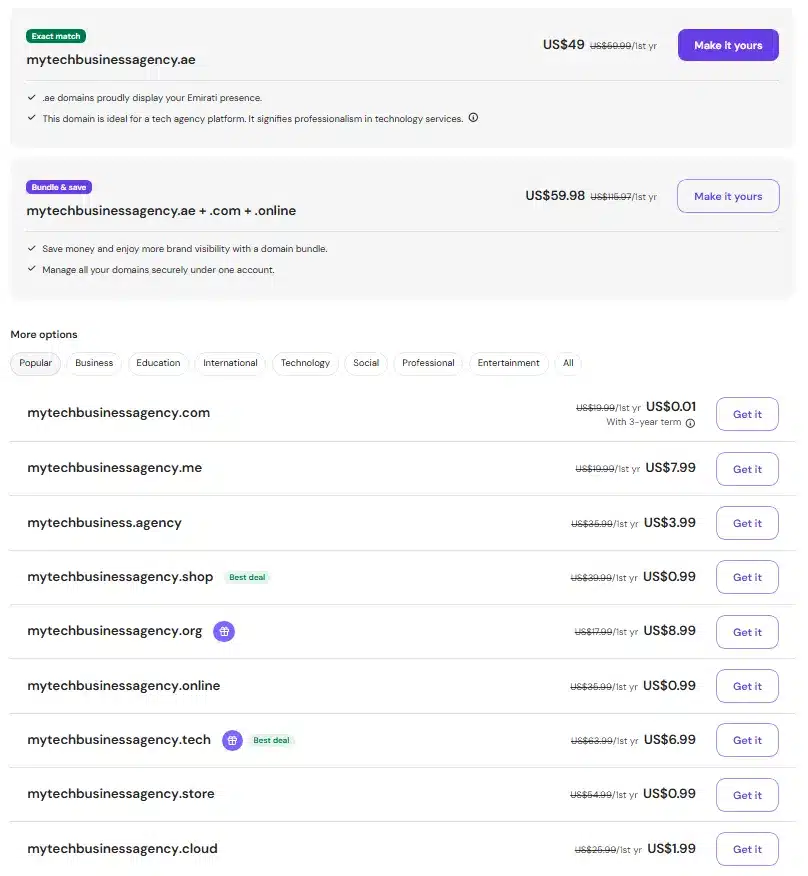
Credit: hostinger.com
Extensions fall into four groups, and knowing them opens up your options.
- Generic (gTLDs). Open to anyone, anywhere. Think .com, .net, .org, .info, .biz.
- Country codes (ccTLDs). Two letters tied to a country: .ae, .pk, .uk, .de. These tell users and search engines where you operate.
- Sponsored (sTLDs). You have to qualify. Only US government bodies get .gov. Only accredited institutions get .edu.
- New gTLDs. Since 2012, we’ve had thousands more: .app, .store, .ai, .io, .design, .agency.
Why does this matter for the .net vs .com choice? Because .net is no longer your only fallback. The pool of alternative domains is far bigger than it was in 2010. A tech startup gets more credibility from .ai or .io today than from .net.
When Does a .com Domain Make More Sense?
Credit: ideastack.com
Almost always. Here’s when it’s genuinely non-negotiable.
- You sell online. People type a .com before handing over card details. That hesitation at checkout is small, but it shows up in your conversion rates.
- You’re building a personal brand; your name is the product, so own the default version of it.
- You want brand recognition without explaining yourself. Nobody asks what .com means.
- You run ads, billboards, or radio spots. Apply the radio test: a listener hears “Apex Widgets” and types apexwidgets.com. If your site lives on .net, you just paid to send a customer somewhere else.
Email is the quieter loss, and the more expensive one. A client types info@yourbrand.com from memory. Your email hosting is on the .net, so it bounces or, worse, reaches a stranger. You never find out the enquiry existed.
When Is .net Actually the Better Choice?
Credit: bluehost.com
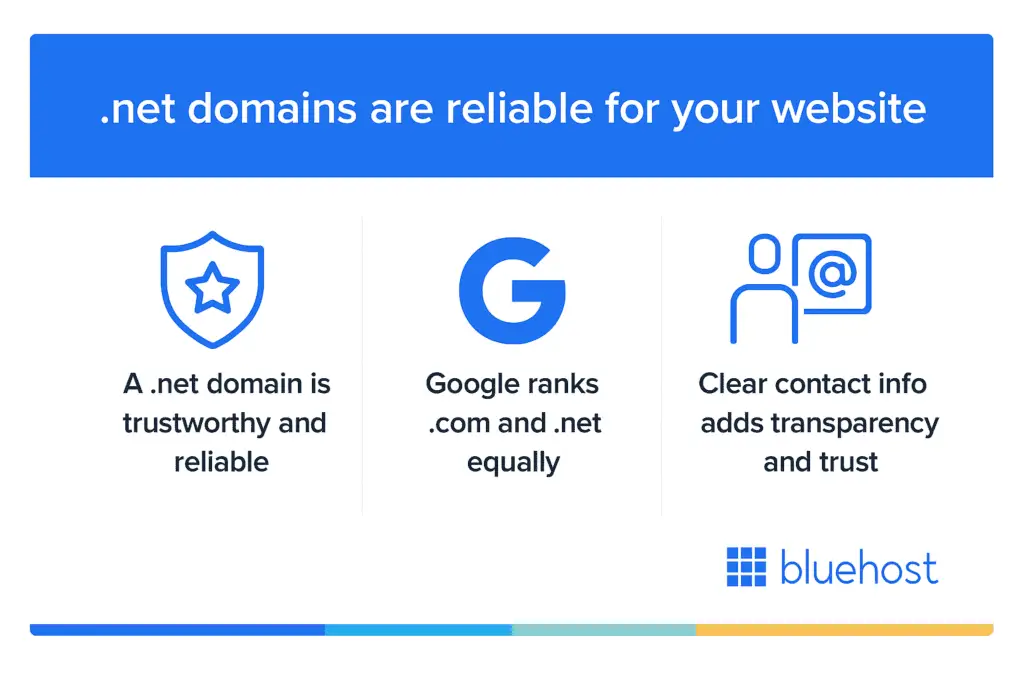
There are real cases, and they’re not consolation prizes.
- You’re in infrastructure. Hosting, ISPs, VPNs, network monitoring, IT services. The .net fits the work. Speedtest.net handles enormous traffic, and nobody thinks less of it.
- You’re building a network of people. Forums, membership sites, communities, open directories. The word “net” does honest work there.
- Your only available .com is bad. Long, hyphenated, or spelt in a way people get wrong. A clean, short .net beats a clumsy .com. And a domain nobody can repeat over the phone is worse than an unexpected extension.
That last one is where most guides go quiet; they shouldn’t.
Does .net vs .com Matter for SEO?
Directly, no. Google confirmed years ago that generic extensions aren’t a ranking factor. You can hold a top search engine ranking with a .net.
Indirectly, there’s a small drag. The .com vs .net SEO gap comes from people, not algorithms.
- Click-through rate. Two results sit side by side. Most people click the .com. Engagement metrics like this feed back into rankings over time.
- Direct traffic. Someone remembers your brand a week later, types it in, adds .com out of habit, and lands nowhere. They go back to Google, where a competitor is waiting.
- Links. Bloggers and journalists lean slightly toward linking the extension that looks like the primary source.
So there’s no penalty. There’s just a slightly steeper hill, and you make it up with content, links, and a site people actually want to stay on.
What If the .com You Want Is Already Taken?
Don’t settle in the first ten minutes. Work through this list first.
- See if it’s actually in use. Plenty of taken names are parked and quietly for sale. A few hundred dollars sometimes close it.
- Add a word that fits. Get, try, HQ, studio, group, agency.
getyourbrand.comReads fine. - Go local.
yourbranddubai.comoryourbranduae.comAlso helps your local search visibility. - Match your sector instead. A store takes .store; a software product takes .app or .io. Alternative domains have come a long way.
- Wait for the drop. Verisign’s renewal figure for .com and .net sat at 76.3% in Q1 2026, so roughly a quarter of names fall off every quarter. Set an expiry alert.
A Quick Note for UAE Businesses: What About .ae?
This one causes real confusion in Dubai, so let’s be precise.
- yourbrand.ae is open. No trade licence, residency, or paperwork. Anyone worldwide can register one.
- yourbrand.co.ae is restricted. You need a valid UAE trade licence or a UAE trademark, and the name has to match that business identity.
- yourbrand.net.ae is tighter still. The trade licence has to specifically list IT services.
Practical advice for a UAE business: take the .com as your main internet presence and the .ae alongside it. The .com carries you globally. The .ae signals that you’re actually here, which matters to local buyers and to Google for UAE searches.
Point the .ae at your .com, or build a proper UAE-targeted version on it. Don’t let it sit empty while you spend on digital marketing.
Should You Buy Both .com and .net?
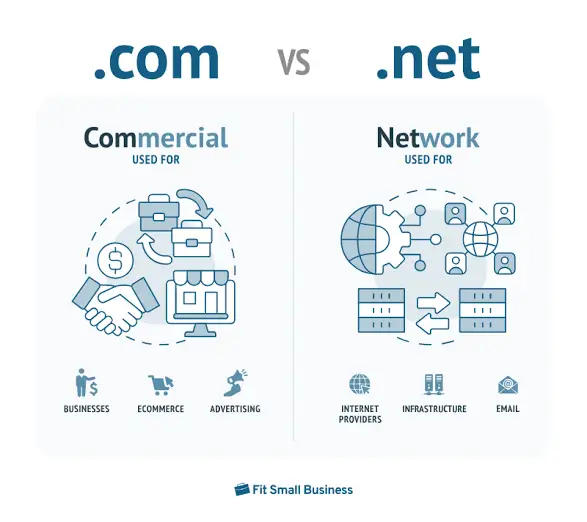
Credit: fitsmallbusiness.com
If the budget allows, yes. Registering both costs less than one client lunch.
Run your site on the .com. Set a 301 redirect from the .net so anyone typing the wrong one still lands on you. No second site to maintain, no split traffic.
The real reason is defensive. You don’t want a competitor buying yourbrand.net two years from now, once you’ve done all the marketing work.
Priority order for most businesses:
- Your .com
- Your .ae, if you operate in the UAE
- Your .net
- The misspelling people actually make
So, .net or .com? Use This Simple Rule
Here’s the test I’d use.
Say your domain out loud to someone who’s never heard of you. If you have to clarify “that’s dot net, not dot com”, you’ll be doing that forever. Every phone call, every event, every handover.
So: pick .com unless your business is literally a network, a community, or internet infrastructure.
And if the .com is gone, change the name before you change the extension. A slightly different .com beats a perfect .net almost every time.
Conclusion
The .net vs .com debate gets treated as a technical question, and it isn’t. Both work identically. Google treats them the same. The difference lives entirely in what people expect and remember.
That expectation is .com, by a factor of thirteen to one.
So chase the .com first, and get creative before you compromise. Keep .net for the cases where “network” is genuinely what you do, or where it buys you a shorter, cleaner name. If you’re operating in the UAE, add the .ae and let it carry your local weight.
Then stop thinking about it. Your domain matters for about a week. Your content, offer, and site experience matter for the next ten years.
If you’re weighing .net vs .com for your business, the domain is only one part of the decision. Our website development team helps businesses build websites around the right domain, structure, performance, and user experience.
Frequently Asked Questions
This is what we get asked the most when it comes to .com vs. .net.
Is a .net domain bad for SEO?
No. Google has confirmed generic extensions aren’t a ranking factor. The impact on SEO is indirect only, through click-through rate and how easily people remember you.
Is .net cheaper than .com?
The cost comparison is closer than people expect, roughly $10 to $30 a year for either. The bigger saving with .net is availability, not price. Check the renewal rate, not just the first-year offer.
Can I switch from .net to .com later?
Yes, but plan it. A domain transfer is the easy part. Migrating the site and setting 301 redirects page by page is the real work, and done badly, it costs you rankings for months.
Do I need a UAE trade licence for a .ae domain?
Not for a standard yourbrand.ae. That zone is open to anyone. You do need a trade licence or trademark for .co.ae, and an IT-specific licence for .net.ae.
Should I buy both the .com and the .net?
If you can afford it, yes. Run your site on the .com and redirect the .net to it. It protects your brand and catches people who type the wrong extension.