

In a world where an average internet user spends six hours and 38 minutes on screen, and you are still failing to promote your product or service to the right audience, I think you need to ask yourself, “What am I doing wrong?” Having a modern website, publishing content consistently, and even emails here and there won’t work if you are not hitting the pain points of customers. Your content brings nothing if it’s not tailored for the right audience. This is where a content writing strategy helps you because it contains deep audience research, clear SEO alignment, and structured formatting.
So, you won’t just randomly publish your content and pray for traffic. The truth is brutal: random content doesn’t build audiences. It just wastes time. Also, there is a difference between publishing content and having a clear content writing strategy, and what you need is a strategy. Not a fancy document or a 40-page PDF nobody reads. Just a clear, practical plan that tells you what to write, for whom, and why. That’s exactly what this guide is about. By the end, you’ll know how to build one from scratch, step by step.
What Is a Content Writing Strategy?

Credit: trebletree.co
A content writing strategy is your master plan for content. It defines what you want to achieve with your content and identifies who you’re writing for. It sets the rules for how you communicate.
Think of it like a roadmap. It tells you where you’re going and who you’re going there to meet. And it tells you why the journey matters.
Without it, you’re just driving around hoping to end up somewhere good.
A solid content strategy and writing plan answers these core questions:
- Why are we creating content?
- Who is our audience?
- What topics should we cover?
- What does success look like?
- How will we stay consistent?
When you answer these, everything else falls into place.
Why Do You Need a Content Writing Strategy?
Here’s a stat that should wake you up. According to HubSpot, businesses with a documented content strategy are significantly more likely to see results from their content efforts than those without one.
Without a strategy, you end up chasing trends. You write about random topics and produce content that doesn’t connect to your business goals.
With a strategy, you:
- Stop wasting time on content that doesn’t convert
- Build authority in your niche over time
- Attract the right audience, not just traffic
- Give your team a clear direction to work from
- Have a way to measure and improve performance
A strategy also helps you say no. That’s underrated. When a stakeholder asks for a random blog post, you can point to your strategy and explain why it doesn’t fit. That’s powerful.
This is also where working with a content strategy agency or investing in content strategy services can make a real difference because they know what works. A fresh external perspective often surfaces what you can’t see from the inside.
Content Strategy vs Plan vs Calendar

Credit: periscopeup.com
People use these three terms interchangeably. They shouldn’t because they’re different layers of the same system.
- Content strategy sits at the top. It’s the high-level “why” and “who.” It connects your content to business goals. It doesn’t deal in the details.
- The content plan goes one level deeper. It’s the “what.” It lists the topics, formats, keywords, and channels you’ll use to execute the strategy.
- A content calendar is the most granular layer. It’s the “when” and “who does what.” It lists specific pieces, deadlines, and publishing dates.
Here’s a simple analogy. Imagine you’re planning a road trip.
Your strategy is the destination and why you’re going there.
The content plan is the route you’ll take and how you’ll travel.
And your calendar is the departure time and rest stops along the way.
All three work together. But they’re not the same thing.
Guide to Creating a Content Writing Strategy
Let’s help you build a clear
Step 1: Identify Your Content Goals & Objectives
Start here, always.
Before you write a single word, get clear on what you want content to do for your business. Your content goals should connect directly to business goals.
Ask yourself:
- Do you want to generate more leads?
- Are you trying to grow organic search traffic?
- Do you want to build brand awareness?
- Is customer retention the priority?
Each goal requires a different content approach. For example, brand awareness calls for educational top-of-funnel content. Lead generation needs persuasive, conversion-focused pieces with a strong call to action.
Once you know your goal, everything else gets clearer.
Step 2: Understand Your Target Audience

Credit: linkedin.com
Content without audience clarity is noise. Period.
You need to know exactly who you’re writing for. Not just “small business owners” or “women aged 25–40.” Go deeper. What keeps them up at night? How many questions are they Googling? What language do they use?
Audience analysis is the foundation of everything. Build a detailed audience persona. Include:
- Demographics (age, location, job role)
- Pain points and frustrations
- Goals and aspirations
- Preferred content formats (video, blogs, podcasts)
Where they spend time online
The more specific your persona, the better your content will perform. Generic content speaks to nobody. Specific content speaks directly to someone.
Step 3: Research Search Intent Before Choosing Topics
This step trips up a lot of businesses. They pick topics they think their audience cares about. Then they wonder why nobody reads the content.
Search intent is the reason behind a search query. It tells you what the person actually wants when they type something into Google. This is a core part of any solid SEO and content strategy.
There are four main types:
- Informational: They want to learn something (“what is content strategy?”)
- Navigational: They’re looking for a specific site
- Commercial: They’re comparing options (“best content writing tools“)
- Transactional: They’re ready to buy
Before you write a piece, ask, “What does the reader actually want?” Match your content to that intent. If Google is ranking how-to guides for a keyword, write a how-to guide.
Step 4: Conduct a Content Audit
Credit: media.adaptocms.com
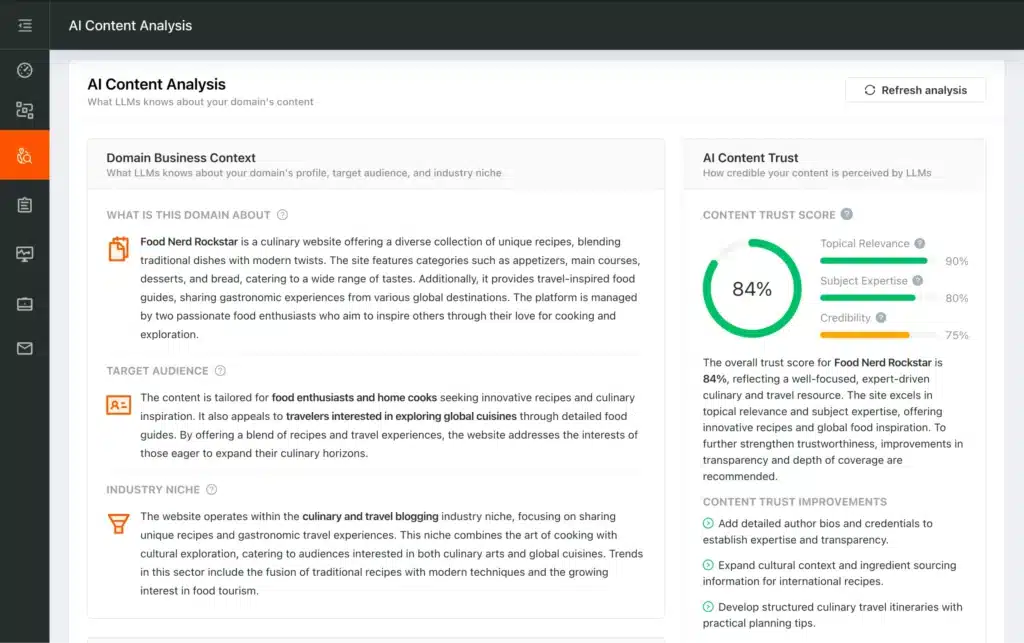
Before creating new content, review what you already have. A content strategy analysis of your existing content is one of the smartest moves you can make.
Look at:
- Which posts drive the most traffic?
- Which ones are completely underperforming?
- Are there outdated pieces that need refreshing?
- Which ones generate leads or conversions?
This audit saves you from duplicating effort. It also surfaces quick wins. Sometimes, updating an old post drives more results than writing five new ones.
Tools like Google Search Console, Ahrefs, and SEMrush can help you pull this data quickly.
Step 5: Analyze Competitors & Find Content Opportunities
Your competitors are a goldmine of content intelligence. Study them.
Look at:
- What topics are they covering?
- What’s ranking well for them?
- What angles are they not covering?
- Where are the gaps you can fill?
A content gap is a topic your audience is searching for, but your competitors aren’t covering well. That’s your opportunity. Own that space before they do.
Don’t copy competitors. Learn from them and then do it better.
Step 6: Create Content Pillars and Topic Clusters
Credit: relevance.com
This is where your strategy starts to take real shape.
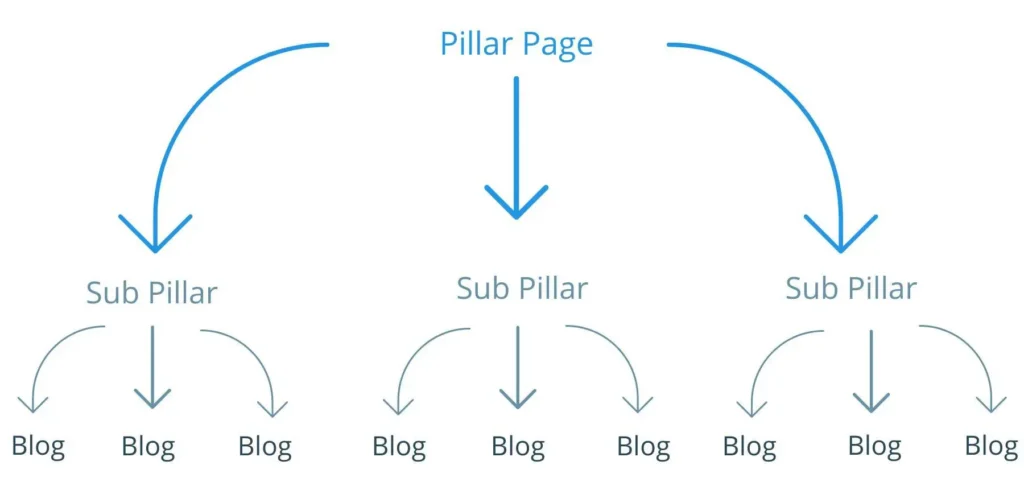
Content pillars are the main themes your brand will own. They should align with your business and audience interests. For example, a digital marketing agency might have pillars like SEO, social media, and content marketing.
Under each pillar, you build topic clusters. These are related subtopics that link back to the main pillar. This structure signals authority to search engines. It also gives your audience a clear, organized resource to explore.
A strong pillar and cluster structure is one of the most effective SEO content strategies you can implement for long-term growth.
If you run an online store, this also forms the backbone of a strong e-commerce content strategy, helping product pages, category pages, and blogs work together as one connected system.
Step 7: Decide Channels Your Content Strategy Should Cover
Not every channel is right for every business. Stop trying to be everywhere.
Think about where your audience actually spends time. A B2B software company might focus on LinkedIn and SEO blogs. A lifestyle brand might thrive on Instagram and YouTube. Social media content and blogging serve very different purposes; know which one fits your goals.
Break your channels into three categories:
- Owned media: Your blog, email newsletter, website
- Earned media: PR, backlinks, social media mentions
- Paid media: Sponsored posts, ads, partnerships
Your strategy should prioritize the channels that offer the best return for your audience type. Start with one or two. Master them. Then expand.
Step 8: Define Your Brand Voice and Guidelines

Credit: images.squarespace-cdn.com
Your brand voice is how you sound. It’s your personality on the page. It’s what makes brand storytelling feel authentic rather than forced.
Are you formal or casual? Bold or gentle? Educational or entertaining? You need to define this clearly. Especially if multiple people are creating content for your brand.
Without voice guidelines, your content becomes inconsistent. A blog that sounds like a professor one week and a stand-up comedian the next confuses readers.
Document your brand voice. Include examples of what to say and what not to say. Make it easy for any writer to pick up and follow.
Also define your content guidelines: preferred writing style, heading structure, link policies, image standards, and word count ranges. These details keep your web content consistent at scale.
Step 9: Build a Content Production Workflow
Great content strategies die without a solid production system. This is where most teams struggle.
A content workflow defines every step from idea to publish. Think of it as your editing process mapped end-to-end:
- Topic ideation
- Keyword research and brief creation
- Writing
- Editing and fact-checking
- Design and formatting
- SEO optimization
- Publishing
- Promotion
Assign clear ownership to each step. Use project management tools like Trello, Asana, or Notion to keep everything organized. A clear workflow prevents bottlenecks and missed deadlines.
Step 10: Create a Content Calendar

Credit: manychat.com
Now that you have your strategy, plan, and workflow, build your content calendar.
A content calendar maps out specific pieces of content, publishing dates, assigned writers, and distribution channels. It gives your team full visibility.
A good content calendar should answer:
- What are we publishing this week/month?
- Who is responsible for each piece?
- When is the deadline?
- Where will this be published and promoted?
Don’t overcomplicate it. A simple spreadsheet works fine when you’re starting out. The goal is clarity and consistency.
Step 11: Measure Content Performance and Improve
Content without measurement is just hope.
Set up tracking from day one. Define your key metrics based on your goals. Some common ones:
- Organic traffic: How many people are finding your content through search?
- Engagement: Time on page, scroll depth, comments
- Leads generated: Form fills, email sign-ups, demo requests
- Conversions: Sales or actions driven by content
Review your performance monthly. Double down on what’s working. Cut or fix what isn’t. Your strategy is a living document. It should evolve as your data tells you more.
This ongoing review process is also what good content strategy consulting looks like in practice; it’s never a one-time setup.
Mistakes Businesses Make When Creating a Content Writing Strategy
Even with the best intentions, teams fall into predictable traps. Here are the big ones to avoid:
Publishing without a goal. If you don’t know why you’re publishing something, neither will your reader.
Writing for search engines, not humans. Keywords matter. But stuffing them into mediocre content won’t work anymore. Write for people first, optimize second. Good SEO strategies always start with genuinely useful content.
Ignoring distribution. Creating content is only half the job. Promoting it is the other half. Many businesses skip this step entirely.
Neglecting effective headlines. Most people decide whether to read based on the headline alone. If your headline doesn’t hook them, nothing else matters.
Skipping the content audit. Starting fresh without reviewing existing content means you miss quick wins and create duplicates.
Trying to be on every channel. This leads to mediocre content everywhere. Focus beats spread, every time.
Not documenting the strategy. A strategy that exists only in someone’s head is not a strategy. Write it down.
Content Writing Strategy Template You Can Follow
Here’s a stripped-back template to get you started. This doubles as a basic content strategy analysis tool you can revisit every quarter:
- Business Goal: What does content need to achieve for the business?
- Target Audience: Who are we writing for? (Persona name, pain points, goals)
- Content Pillars: What are our 3–5 core topics?
- Primary Channels: Where will we publish?
- Brand Voice: How do we sound? (3 adjectives + examples)
- Success Metrics: What KPIs will we track?
- Publishing Cadence: How often will we publish?
- Review Schedule: When will we review and update the strategy?
Fill this in honestly. Even a one-page strategy is better than nothing. Start simple and add detail as you grow.
Conclusion
I think we are clear by now that most businesses don’t have a content problem. They have a strategy problem; they publish content and stay busy. But without a clear direction, they get nowhere. A content writing strategy changes that. It gives your content a purpose and your team a direction. And it gives your business a real shot at growing through content.
If you want help building a content strategy that actually drives results, the team at Hashtag Media is ready to help.
Frequently Asked Questions
Here are a few questions you might want to look at before building your next strategy.
What is a content writing strategy?
A content writing strategy is a documented plan that defines your content goals, target audience, key topics, brand voice, and how you’ll measure success. It ensures every piece of content you create has a clear purpose.
How long does it take to build a content writing strategy?
You can build a basic strategy in a few days. A more detailed strategy that includes audience research, competitor analysis, and content audits may take two to four weeks to complete properly.
How often should I update my content strategy?
Review your strategy at least every six months. Monthly check-ins on performance metrics are also a good idea so you can catch and fix underperforming content quickly.
Do small businesses need a content writing strategy?
Absolutely. In fact, a content strategy matters even more for small businesses because resources are limited. A strategy ensures every piece of content you produce is working toward a specific goal, so nothing is wasted.
What’s the difference between content strategy and content marketing?
Content strategy is the plan; it defines the goals, audience, and approach. Content marketing is the execution; it includes the actual creation, publishing, and promotion of content. You need both, but strategy comes first.